
Christ the Wormhole
A Cosmic Metaphor

A few weeks ago, my Instagram FYP kept showing me videos of black holes. These videos took me down a rabbit hole of learning a bit about black holes, white holes, and wormholes. I am by no means an expert in any of those things, but I do find them to be fascinating.
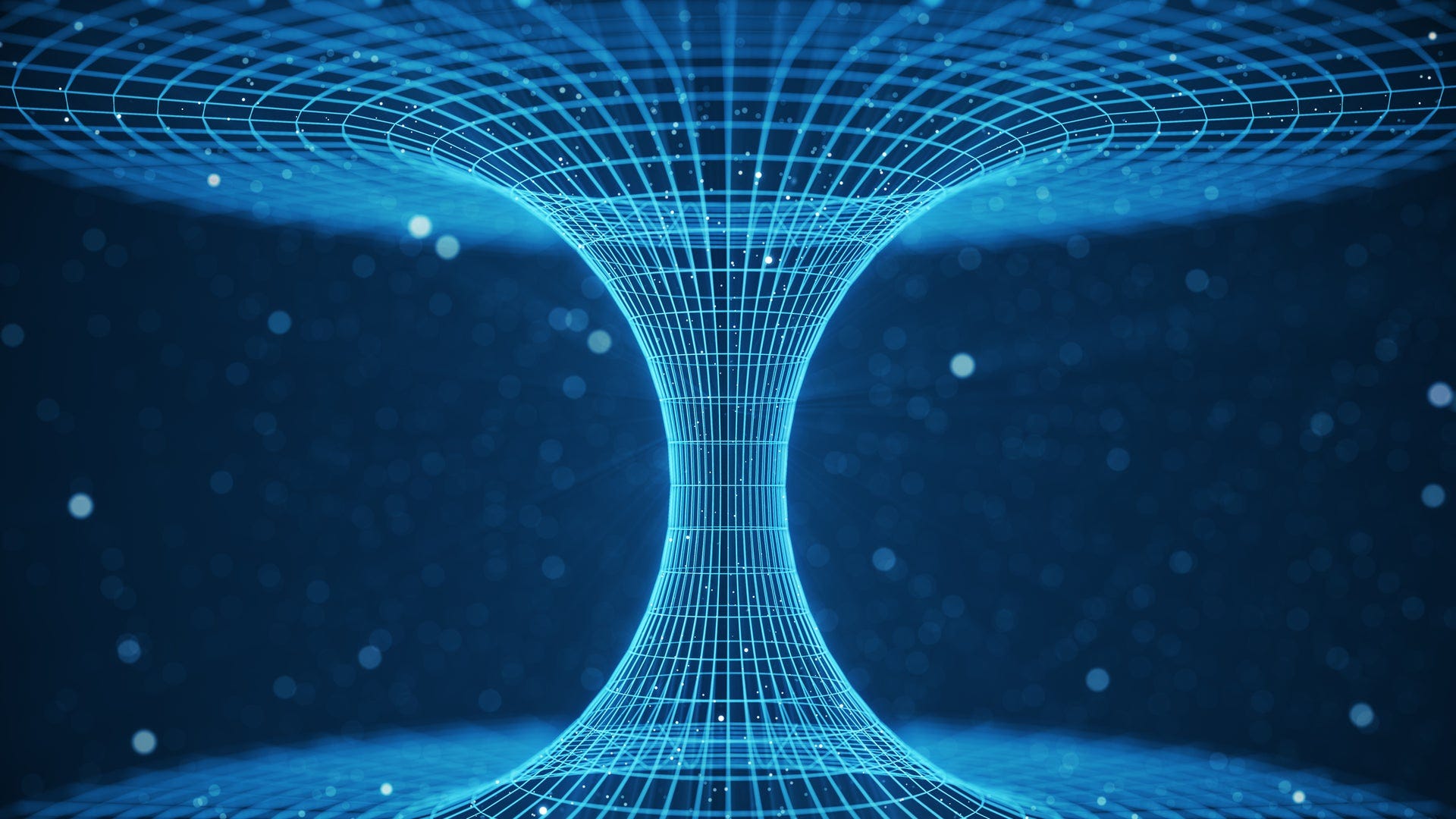
I think these different kinds of holes are helpful when looking at the salvific work of Christ. There is a strong metaphor that can be drawn from the connection of these holes and the life, death, and resurrection of Jesus Christ.
Theology often reaches for poetry because ordinary language cannot contain the mystery it seeks to describe. Poetry, such as metaphors, invites us to think imaginatively. The early Christians spoke of Christ as the Lamb, the Vine, the Door, the Cornerstone, the Sun of Righteousness, and even the Second Adam. Each image reveals something true while acknowledging that none can reveal everything.
So I have another metaphor for us to consider.
What if Jesus is like a wormhole?
I often talk about the Lord of all the Cosmos, so this metaphor makes sense to me.
In theoretical physics, a wormhole is envisioned as a passage connecting two otherwise distant realities. Though purely hypothetical, it provides a compelling picture of movement through what appears impassable. It bridges what seems impossible to bridge.
The cross and resurrection of Jesus Christ do something beautiful. They unite heaven and earth, God and humanity, and death and everlasting life. Christ becomes the living passage through which creation is reconciled to its Creator.
Yet the metaphor grows richer.
From one side, Christ resembles a black hole. Black holes possess such immense gravity that nothing, not even light, can escape once it passes the event horizon. Everything is drawn inward.
At Golgotha, Jesus becomes the place where the gravity of the world’s sin converges. The hatred of humanity. The violence of empire. The betrayal of friends. The weight of sin. The curse of death itself. Everything broken in creation rushes toward him. “For our sake God made the one who knew no sin to be sin, so that in him we might become the righteousness of God” (2 Corinthians 5:21).
Like a black hole swallowing collapsing stars, Christ gathers into himself every force that opposes the life of God. Sin disappears into the abyss of divine mercy. Death itself is done away with through Jesus Christ.
The cross is where evil reaches its greatest concentration—and where its power begins to unravel.
Physics has imagined, but never observed, the opposite of a black hole: a white hole. If a black hole only receives, a white hole only gives. Everything flows outward.
Again, the image is imaginative rather than scientific, but it beautifully evokes Easter morning. From the tomb bursts forth life, forgiveness, light, and abundance. The One who swallowed death now breathes immortality into creation. The resurrection of Jesus becomes an ever-flowing spring.
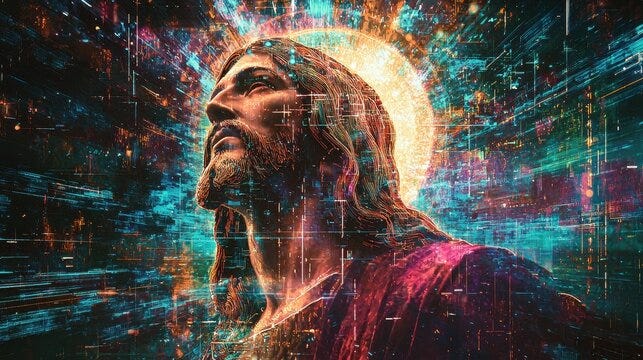
The white-hot brilliance of Easter pours into the world. Grace. Peace. Mercy. Joy. Hope. New creation. The resurrection is not merely Jesus escaping death. It is Life overflowing into a dying universe.
We have explored Jesus as a black hole and a white hole. What connects these two is known as a wormhole. A wormhole is not simply a destination. It is a passage. Jesus repeatedly speaks this way about himself.
“I am the Door.”
“No one comes to the Father except through me.”
“I am the Way.”
These are not merely statements about doctrine. They are invitations to participate in his life. We enter Christ in baptism. We die with Christ. We rise with Christ. The old self passes into the black hole of the cross where sin loses its hold. A new creation emerges through the white hole of resurrection where grace becomes the atmosphere of existence.
Paul describes this movement succinctly: “So if anyone is in Christ, there is a new creation: everything old has passed away; look, new things have come into being!” (2 Corinthians 5:17). Jesus is the passage from death to life.
Since Christ is the passage between death and life, then the Church is called to become a people who live on the resurrection side of the wormhole. We do not return evil for evil because vengeance has already been swallowed. We do not cling to shame because forgiveness continually pours forth. We do not fear death because death has already entered Christ and failed to overcome him. Every act of mercy becomes an echo of Easter. Every forgiveness reflects the resurrection. Every table shared with strangers becomes evidence that abundance is stronger than scarcity. The Church lives downstream from the white hole. We become conduits of the life continually flowing from the risen Christ.
Of course, the wonder of the Gospel is greater than any image physics can provide. Still, perhaps this cosmic picture helps us glimpse something beautiful. On Good Friday, all sin, violence, despair, and death rush toward Christ, who receives them into himself and overwhelms them of their power. On Easter morning, life emerges with light, grace, and the inexhaustible abundance of God’s new creation.
Christ is the passage through whom the old world dies, and the new world begins.
And anyone who enters him discovers that on the other side of death stands not emptiness, but the radiant, overflowing life of God.
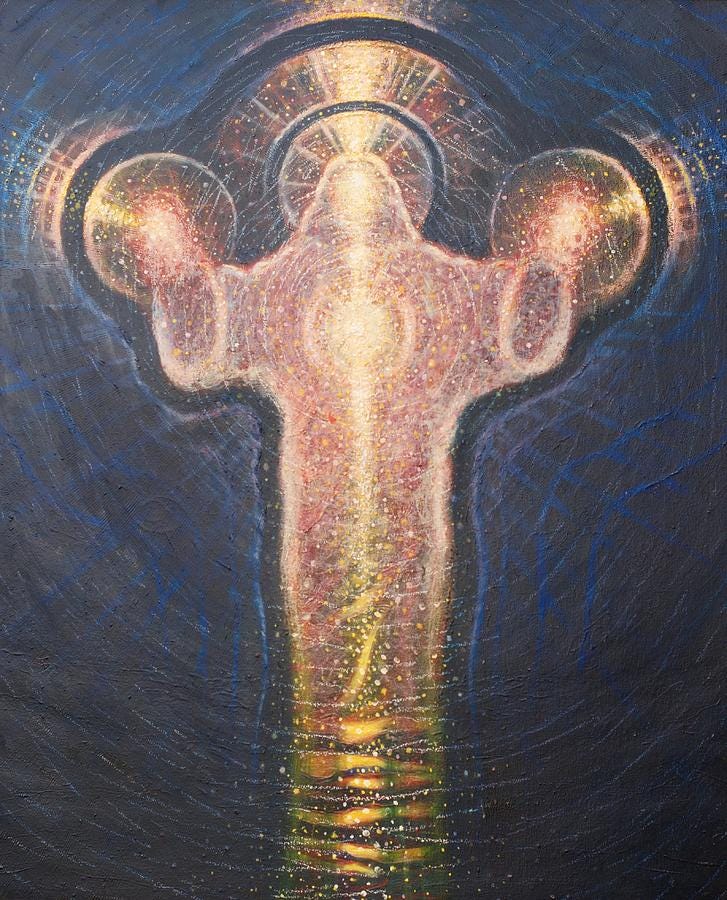
Aquinas speculated that angels move from place to place without passing through the space between: no time, no transit. I've always pictured the risen Christ moving the same way: appearing to Mary in the garden, standing in the Upper Room with the doors locked, walking the road to Emmaus, then vanishing. Wormhole, huh? I like that.
Hmmmm. I wonder if this metaphor undersells the incarnation a bit. A wormhole connects two separate realities, but Jesus doesn't just connect God and humanity, he actually brings them together in himself. That feels like an even stranger mystery.